
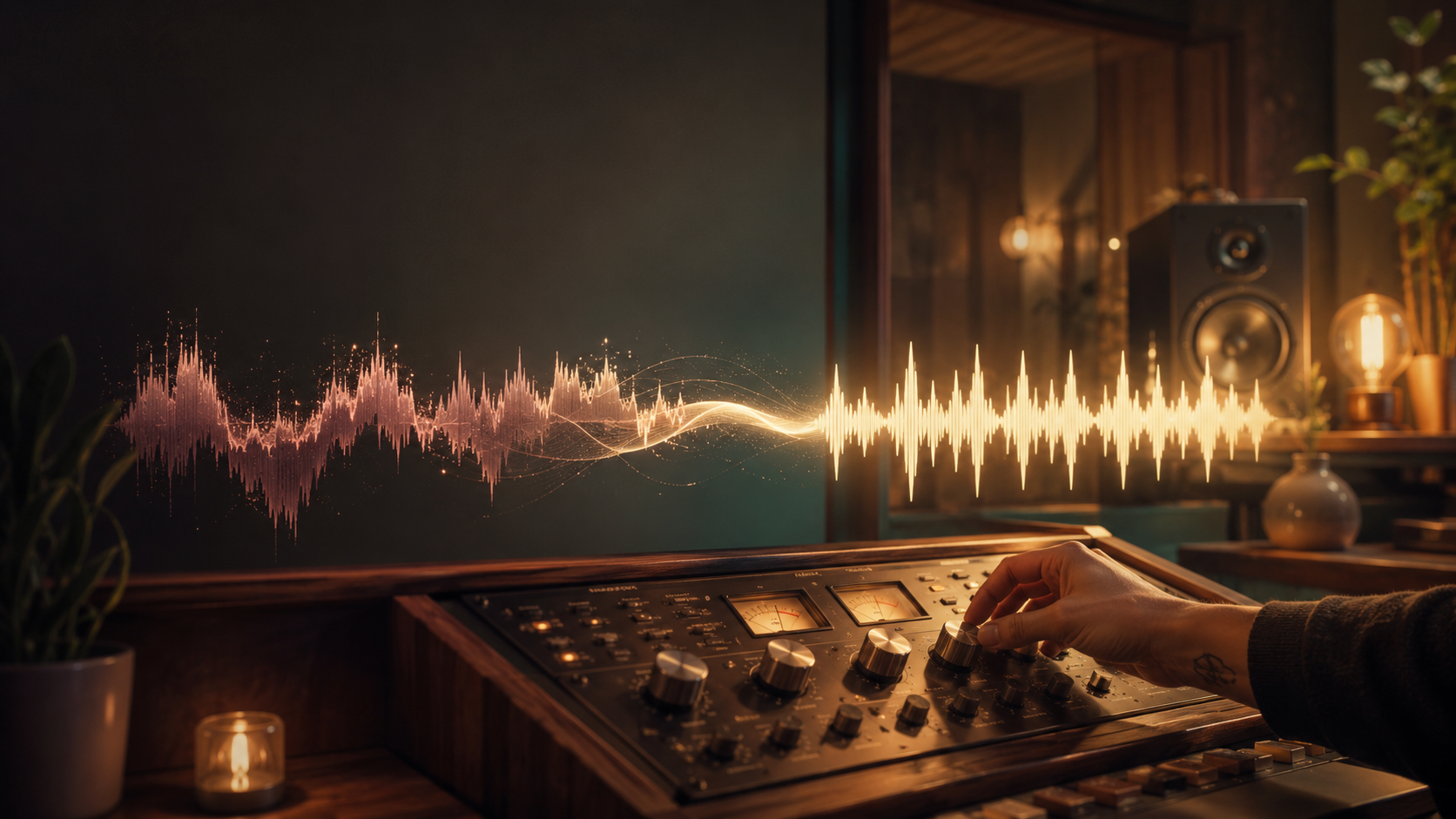
AI music tools can produce an impressive song in minutes. The melody works, the vocal carries emotion, and the chorus stays with you—but a finished generation is not always a finished release.
If you want listeners to remain with the song, replay it, or add it to a playlist, mastering matters.
A strong song can still be difficult to listen to
AI-generated vocals often sound convincing on first listen, especially through headphones. Problems may become more noticeable when the track is played on a phone, in a car, through inexpensive speakers, or alongside professionally released music.
You might hear:
Sharp or brittle consonants
Harshness in the upper vocal range
Bass that overwhelms the words
A chorus that suddenly becomes too loud
Instruments competing with the vocal
A mix that feels narrow, flat, or tiring
Distortion during the busiest parts of the song
None of these necessarily mean the song itself is poor. They usually mean the audio needs a final stage of balancing before release.
Mastering helps the vocal belong in the track
One of the most common problems with AI music is that the vocal can feel as though it is sitting on top of the instruments rather than living among them.
Mastering can help bring the different parts of the song into a more coherent whole. Careful EQ can soften harsh frequencies, controlled compression can reduce uncomfortable jumps in volume, and sensible stereo processing can give the arrangement space without pushing the lead vocal away from the centre.
The aim is not to strip away the character of the generated voice. It is to help that character reach the listener without unnecessary distractions.
Loudness is not the same as impact
It is tempting to make a track as loud as possible, particularly when comparing it with commercial releases. However, excessive loudness can flatten the dynamics that give a performance its emotional shape.
A gentle verse should have room to breathe. A chorus should feel larger because the arrangement and performance open up—not simply because everything has been pushed against a limiter.
Streaming services may also adjust playback levels, so forcing a track to be extremely loud rarely provides the advantage creators expect. It can instead introduce clipping, distortion, and listening fatigue.
Good mastering aims for controlled, consistent loudness while preserving the moments that make the song feel alive.
Your listeners will not all hear the same version
You may create and review your music on one familiar set of headphones, but your audience will listen in many different ways:
Through a phone speaker
On earbuds
In a car
Through a television
On a smart speaker
With a full home audio system
A mix that sounds warm on studio headphones may become muddy on a small speaker. A bright vocal may turn painfully sharp through earbuds. Deep bass may disappear entirely on a phone.
Mastering cannot make every playback system identical, but it can help a track translate more reliably between them.
Mastering supports the story you are telling
For independent and AI-assisted creators, mastering is not only a technical process. It is another creative decision.
A lively tavern song may need a firm rhythmic pulse, clear vocals, and the feeling of musicians performing together in a room. A quiet ballad may need warmth, closeness, and enough dynamic space for the words to land.
Treating every track with the same preset can work against that intention. The right master should support the atmosphere of the song rather than replace it with a generic “commercial” sound.
This is especially important for story-led music. The listener needs to hear the lyric, understand the emotion, and remain inside the world of the track. If harshness, sudden volume changes, or competing frequencies pull their attention away, the story loses some of its power.
Mastering cannot repair everything
Mastering is the final polish, not a cure for every problem.
It cannot fully correct unclear lyrics, broken pronunciation, an unsuitable arrangement, or severe generation artefacts. If the vocal performance itself is not working, regenerating the affected section or choosing another version will usually produce a better result than trying to force it into shape later.
The strongest workflow is:
Choose the best generation.
Listen carefully for vocal and instrumental artefacts.
Correct or regenerate major problems.
Prepare the cleanest available audio.
Master the track for its intended mood and release platform.
Test it on several different speakers before publishing.
Mastering works best when the creative foundation is already sound.
AI-assisted music still deserves a proper finishing process
Using AI does not remove the need for human judgement. In many ways, it makes that judgement more important.
The tool may generate the performance, but the creator still decides which version carries the right emotion, which imperfections are acceptable, how the song should feel, and when it is ready to meet an audience.
Mastering is part of taking responsibility for that final experience.
At Hearthlight Creative Studios, this idea shaped the development of SoundSmith: a mastering workspace designed to help independent and AI-assisted creators understand what their track needs while keeping control of their work. The goal is not to make every song sound the same. It is to help each track sound closer to what its creator intended.
Your song has already done the difficult part: it has found something worth saying. Mastering helps make sure the listener can hear it.